
We Buy
Silverware
Georgian and Regency silver, tea sets, trays and trophies — valued on both hallmark craftsmanship and weight.
What Makes Silverware Collectible
Sterling silverware is regulated by hallmarking systems that record the metal's purity, maker, and origin: British pieces since medieval times carry a lion passant for the 925/1000 sterling standard alongside an assay office mark and date letter. We value silverware on two axes at once: its bullion or "melt" weight in troy ounces, and its craftsmanship and rarity premium, which reflects maker reputation, age, design, and condition. A piece by a celebrated smith, in crisp original condition with clear, matching hallmarks, can be worth many times its raw silver content, while worn, heavily monogrammed, or unmarked pieces trade closer to scrap value.
Makers & Items We Buy
Candle Sticks
Silver candlesticks are among the most enduring forms of domestic silver, produced in English workshops from the 17th century onward and reaching a peak of refinement in the Georgian (1714-1830) and Regency periods. Georgian examples range from the plain, architectural columns of the early 18th century to the ornate Regency taste for classical urns, gadrooned borders, shells, and lion-mask or paw-foot detailing. We look for full, correctly matching hallmarks (maker, assay town, date letter, and lion passant sterling mark), and pairs or larger matched sets command a significant premium over single sticks. Condition, gauge of silver, and the reputation of the maker are the key drivers of value.
Late Georgian & Regency Silver Mugs
Silver mugs, especially christening mugs given as gifts to mark a child's birth, trace their form to older communal drinking vessels and were prized both for silver's association with health and purity and for their lasting sentimental value. Late Georgian and Regency examples (broadly George III to George IV, circa 1760-1830) move from the restrained, tapered simplicity typical of mid-Georgian silver to the more robust, classically inspired shapes with reeded or gadrooned bands, scroll handles, and applied ornament characteristic of the Regency style. We look for crisp, legible hallmarks and an unaltered cartouche; because many mugs were engraved and later re-engraved for successive family occasions, we check the engraving area for thinning of the metal. Rarity of early 18th-century survivors, maker reputation, and overall condition are the principal value factors.
Silver Cutlery
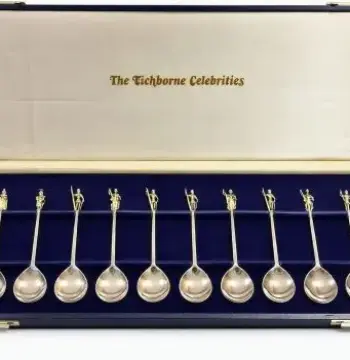
Antique silver cutlery, or flatware, was typically produced as part of a matched "canteen" — a full table service of knives, forks, and spoons housed in a fitted case — a format that became especially popular from the Georgian period through the Victorian and Edwardian eras. The single most important distinction for buyers is between solid sterling silver, marked with a lion passant and full hallmark set, and silver plate (marked EPNS or EP), since this determines whether a piece has meaningful intrinsic bullion value at all. Value is built from a combination of melt value, pattern desirability, maker reputation (celebrated smiths such as Paul Storr command a strong premium), and completeness of the set, with unmonogrammed, undamaged, full canteens fetching the highest prices.
Silver Trays
The silver salver — a flat, handleless serving tray raised on small feet — has its origins in 16th-century practices of testing food and drink for poison before it reached a noble table, evolving by the 18th and 19th centuries into a prominent display of a household's wealth and status. Georgian and Regency examples show the era's characteristic decorative vocabulary, from restrained gadrooned or rope-twist borders in the early 19th century to more elaborate chased and pierced work later on, hallmarked around the rim or underside with maker, assay town, date letter, and sterling standard mark. Because trays are among the heavier forms of domestic silver, weight has an outsized effect on value alongside condition, rarity, and the standing of the maker.
Tea Sets
Silver tea services emerged in Britain as tea drinking became fashionable among the aristocracy from the late 17th century, with the silver teapot itself dating to around 1627 and matching sets of teapot, coffee pot, sugar bowl, and cream jug becoming standard by the Georgian era. Georgian and Regency tea sets reflect the neoclassical tastes of the period — fluted or gadrooned bodies, oval and boat shapes, and applied classical motifs — produced by noted makers such as Paul Storr and the Hennell family, whose work is still actively sought at auction today. Value is driven chiefly by silver content, the reputation of the maker or retailer, total weight, and condition, with complete, correctly hallmarked sets by well-regarded makers commanding significantly more than incomplete or heavily worn services.
Trophies
Presentation and trophy silver flourished from the Victorian era into the early 20th century, as sporting and social clubs proliferated and turned to silver — durable, prestigious, and produced by an established network of British silversmiths — as the natural medium for commemorating victories and milestones. Many trophies from this period were bespoke commissions bearing elaborate presentation inscriptions, engraved crests, or coats of arms, which can add considerably to a piece's historical interest and value when the provenance is traceable to a known event, club, or family. As with other silver forms, we weigh hallmarks, maker (renowned Sheffield and Birmingham firms such as Walker & Hall and Elkington are particularly prized), age, and silver quality, with handmade pieces from roughly 1750 to the early 20th century regarded as the most collectible bracket.
Get an Instant, No-Obligation Offer
Send us photos via WhatsApp or book a home visit — our specialists travel to you anywhere in South Africa.