
We Buy
EPNS
Electro-Plated Nickel Silver cutlery sets and candlesticks — Sheffield and Birmingham craftsmanship from the Victorian and Edwardian eras.
What Makes EPNS Collectible
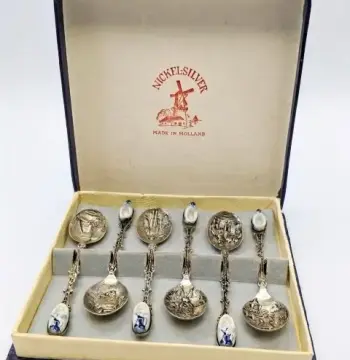
EPNS stands for Electro-Plated Nickel Silver: a base-metal alloy of copper, nickel and zinc (also called nickel silver or German silver, containing no actual silver itself) that is coated with a thin layer of pure silver through electroplating. The process was patented in 1840 by the Elkington brothers, revolutionising the silverware trade by letting manufacturers produce items with the look of solid silver at a fraction of the cost, and it quickly displaced the earlier fused "Old Sheffield Plate" technique. Unlike sterling silver, which is 92.5% silver throughout and carries a full assay hallmark, EPNS pieces are marked only with letters such as EPNS, EP or A1 and have no meaningful melt value — yet they remain widely collected today for their craftsmanship, ornate Victorian and Edwardian designs, and affordability compared to solid silver equivalents.
Makers & Items We Buy
Sheffield Cutlery Sets
Sheffield has been England's cutlery and silverware capital since medieval times, formalised by the Company of Cutlers in Hallamshire in 1624, and it was in this city that Thomas Boulsover developed fused Old Sheffield Plate in the 1740s, the direct forerunner of electroplating. From 1840 the new electroplating process, refined and popularised by firms such as Elkington & Co., allowed Sheffield manufacturers to mass-produce cutlery with a silvered finish, and major houses including Walker & Hall, James Dixon & Sons, Mappin & Webb, Atkin Brothers, Roberts & Belk and Cooper Brothers turned out much of the flatware found in Victorian and Edwardian British homes. Vintage Sheffield EPNS canteens are marked on the back of the handle near the blade or tine join, typically with EPNS plus a grade indicator such as A1 (denoting the heaviest standard silver deposit). Collectibility and value hinge on completeness of the set, a recognisable pattern and maker's mark, and the condition of the plating — heavy original plating holds value well, while wear to the base metal or later re-plating can significantly reduce it.
Candle Sticks
EPNS candlesticks became hugely popular during the Victorian and Edwardian eras (roughly 1860-1900), when affordable electroplating let ordinary households own elaborately decorated silver-look lighting that had previously been the preserve of the wealthy. Common styles include Neoclassical Corinthian-column designs with fluted shafts and stepped square bases, telescopic or "travelling" candlesticks that collapse for storage, and smaller chamber sticks with wide dish-like bases and carrying handles, often produced in pairs or sets of four. Many candlesticks have bases weighted with lead or resin for stability, a feature that also makes them heavier and more substantial to handle than they first appear. Value is driven by maker's mark, the ornateness and originality of the design, the condition of the silver plating, and whether the piece survives as a genuine pair or matched set rather than a single stick.
EPNS Currently For Sale
Get an Instant, No-Obligation Offer
Send us photos via WhatsApp or book a home visit — our specialists travel to you anywhere in South Africa.