
We Buy
Antique Cameras & Telescopes
Carl Zeiss, Leica, Hasselblad, Rolleiflex and other collectable camera and optical makers — we buy working and non-working examples alike.
What Makes Antique Cameras & Telescopes Collectible
Antique cameras and telescopes are collected for their engineering craftsmanship, historical significance, and the tactile connection they offer to the early history of photography and optics. Value in this category is driven by brand reputation, rarity of a given model or variant, originality (matching serial numbers, original cases and accessories), and mechanical/optical condition, with documented provenance tying a piece to a notable event, expedition, or photographer adding a further premium. Because many of these instruments were built to a genuine working standard rather than mass-produced disposably, well-preserved examples from respected makers are prized as much for their precision engineering as for their age.
Makers & Items We Buy
Carl Zeiss
Carl Zeiss founded his optical workshop in Jena, Germany, in 1846, and with the scientific partnership of physicist Ernst Abbe and glass chemist Otto Schott, the firm became the world's foremost name in precision optics by the late 19th century. Zeiss lens designs such as the Tessar, Sonnar, and Planar set the benchmark for sharpness and were fitted to cameras from Contax to Hasselblad and Rolleiflex throughout the 20th century. After WWII the company split into Carl Zeiss Jena (East Germany) and Zeiss Oberkochen/Opton (West Germany), producing two distinct lineages collectors track separately, including the sought-after "Zebra"-finish Jena lenses of the 1960s. Value depends on lens type, coating generation, finish, and country of manufacture, with clean, fungus-free early examples commanding the strongest prices.
Graflex
Graflex traces its roots to the Folmer & Schwing division of Eastman Kodak, becoming an independent American manufacturer in 1926 and building on a press-camera lineage stretching back to 1912. Its Speed Graphic and Crown Graphic large-format cameras became the definitive tool of American photojournalism from the 1920s through the 1950s, used by photographers such as Weegee to capture some of the century's most iconic news images. Collectors particularly seek WWII-era examples, models fitted with rangefinders and flash sync, and cameras retaining their original lenses (Kodak Ektar, Wollensak Raptar, or the rare Graflex Aero-Ektar). Because these were rugged working press cameras, the condition of the bellows, shutter curtain, and ground glass is critical to both usability and value.
Hasselblad
Founded in Gothenburg, Sweden, the Hasselblad camera business grew out of a 19th-century trading company and launched its first product, the revolutionary 1600F, in 1948 — the world's first medium-format single-lens reflex camera with an interchangeable-lens, interchangeable-back modular system. Early Series One and Series Two 1600F/1000F models were produced in very small numbers and are now scarce, while the later 500-series became the workhorse of professional studio and fashion photography. Hasselblad's greatest claim to fame is its use by NASA on the Apollo Moon missions, a pedigree that adds enormous cachet to space-programme-related models. Because of their mechanical complexity, value hinges heavily on full working order, plus the presence of original film backs, finders, and boxed documentation.
Kodak
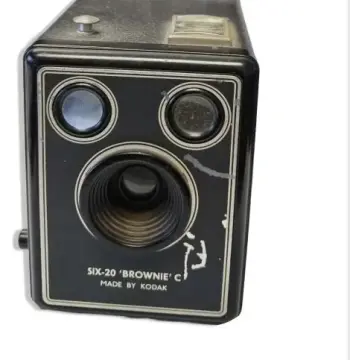
Founded by George Eastman, Eastman Kodak revolutionised photography by making it accessible to ordinary consumers, most famously with the $1 Brownie box camera launched in 1900 and designed by Frank Brownell. Kodak produced an enormous range of models over the following decades, from folding pocket cameras to the striking Art Deco "Beau Brownie" of 1930 in its rose and green colourways. Most Brownies and folders are common and modestly priced, but early production runs, unusual colourways, and complete, boxed, working examples can command significantly higher prices. Collectibility generally rests on aesthetic design appeal, historical role in democratising photography, and the condition of the bellows, shutter, and body.
Leica
Leica traces its origins to the Ernst Leitz optical works in Wetzlar, Germany, and to Oskar Barnack's experimental 1913 "Ur-Leica," the prototype that established the compact 35mm camera format. The production Leica I of 1925 and the rangefinder-equipped Leica II of 1932 set the template for decades of interchangeable-lens 35mm cameras, culminating in the landmark M3 of 1954, whose combined viewfinder/rangefinder remains a benchmark design. Leica is widely regarded as the most collected camera brand in the world, and rare early screw-mount models, military-marked wartime examples, and limited variants have sold at auction for hundreds of thousands to millions of euros. For more ordinary examples, value is driven by model, matching lens, originality of finish, and full mechanical function, with clean, honestly-used cameras still keenly sought by collectors and working film photographers alike.
Le Maire
Le Maire (also seen as Lemaire, or "Le Maire Fabt, Paris") was a Parisian optical firm founded in 1846, producing opera glasses, binoculars, and small telescopes from workshops on the Rue Oberkampf before relocating to Crosne, south of Paris, in 1892. The firm is credited with inventing a mechanism allowing simultaneous focusing of both barrels on binoculars and opera glasses, a genuine innovation in 19th-century optical design, and it exported instruments worldwide under its well-known bee trademark until closing in 1955. Collectors value Le Maire pieces for their fine leather and mother-of-pearl finishes, engraved brass fittings, and maker's marks, with ornate 19th-century cased examples considered the most desirable. Because these were precision hand-finished instruments of their era, the condition of the optics and smoothness of the mechanical action significantly affect value.
Marina
Marina is a trade name found on brass draw-tube telescopes and spyglasses of the type widely produced for maritime and naval use during the 20th century, typically featuring leather-bound brass barrels, turned wood or bone grips, and multi-section draw construction associated with ship's officers' instruments. Unlike the major optical houses in this category, Marina-branded pieces are less thoroughly documented in collector references, and surviving examples are generally associated with continental European workshops supplying naval and merchant marine outfitters rather than a single well-recorded factory. Collectible value for this type of instrument rests on the condition of the brass and leather, smoothness of the draw action, clarity of the original optics, and completeness with an original leather carry case. We examine engraved markings closely, as maker names, naval insignia, or presentation inscriptions can meaningfully affect a piece's history and worth.
Rolleiflex
Rolleiflex was the flagship product of Franke & Heidecke, a German firm founded in Braunschweig in 1919 by two former Voigtländer employees, Paul Franke and Reinhold Heidecke. Launched in 1928, the Rolleiflex twin-lens reflex camera used Heidecke's innovative periscope-style dual-lens design paired with Zeiss Tessar optics, and it became the defining professional camera of mid-20th-century photojournalism and studio work, alongside its more affordable sibling, the Rolleicord. Collectors prize early pre-war models, automat film-advance versions, and the top-of-the-line 2.8-series with faster lenses, all valued for their exceptional build quality and optical performance. Because the company ceased and restarted production more than once before its final closure, completeness, cosmetic condition, and a functioning shutter and viewing mechanism are the main determinants of value today.
Sinar
Sinar was founded in Switzerland in 1948 by Carl Hans Koch, whose family had run photography studios since the 1870s, building on the modular Sinar Norma large-format view camera he had developed in his own garage the year before. The Norma and its successors, the Sinar P (1970) and Sinar P2 (1984), became the professional benchmark for monorail view cameras used in studio, architectural, and product photography, prized for their precise swing, tilt, and shift movements and rock-solid engineering. Sinar was also a technical pioneer, introducing one of the first microprocessor-controlled shutter and exposure systems and an early professional digital back. Collectible and working value depends on completeness of the modular system (standards, bellows, rail, and lens boards), condition of the bellows and ground glass, and the Swiss build quality that keeps these cameras usable by large-format photographers today.
Voigtländer
Founded in Vienna in 1756 by Johann Christoph Voigtländer, Voigtländer is recognised as the oldest name in camera and optics manufacturing, producing mathematical and optical instruments long before photography existed. The firm produced the first Petzval portrait lens in 1840 and the world's first all-metal daguerreotype camera the same year, later relocating its headquarters to Braunschweig, Germany, where it went on to introduce innovations including the first 35mm zoom lens (1959) and the first compact camera with built-in electronic flash (1965). Collectible Voigtländer pieces span nearly two centuries, from ornate 19th-century brass-and-wood daguerreotype cameras to elegant folders and rangefinders of the 1930s-50s such as the Bessa and Prominent. Rarity, completeness with original lenses, and the historic significance of very early instruments make Voigtländer pieces of particular interest to specialist collectors of photographic history.
Yashica
Yashica began in December 1949 as the Yashima Seiki Company in Nagano, Japan, initially manufacturing clock components before releasing its first camera, the twin-lens reflex Yashimaflex, in 1953. The firm adopted the Yashica name in 1958 after acquiring the Nicca Camera Company, whose rangefinder expertise helped it expand into 35mm cameras, and its 1957-launched Yashica Mat TLR series — culminating in the 1970 Mat-124G — became some of the most popular medium-format cameras of the era. In December 1965 Yashica introduced the Electro 35, the world's first commercially successful electronically controlled 35mm rangefinder, which went on to sell roughly 8 million units across its variants. We particularly value clean, working Yashica Mat TLRs and Electro 35 rangefinders with original meters and light seals in good condition, along with cameras retaining lenses from Tomioka Optical, the lens maker Yashica acquired in 1968.
Zeiss Ikon
Zeiss Ikon was formed in Dresden, Germany, in 1926 through the merger of four German camera manufacturers under the Carl Zeiss optical group, quickly becoming one of the most technically ambitious camera makers of the pre-war era. Its most celebrated line was the Contax rangefinder, launched in 1932 as a direct rival to Leica, offering a bayonet lens mount, longer rangefinder base, and removable back years ahead of competitors, followed by the Contax S of 1949, one of the earliest pentaprism SLR cameras in the world. Post-war production split between Dresden in the East and a rebuilt West German operation around Stuttgart, which produced the well-regarded Contax IIa/IIIa models from 1950. Collectors seek rare pre-war variants (including scarce "chrome face" examples), complete outfits with matching Zeiss lenses, and cameras in full mechanical working order, all of which command a premium over the more common late-model versions.
Antique Cameras & Telescopes Currently For Sale
Get an Instant, No-Obligation Offer
Send us photos via WhatsApp or book a home visit — our specialists travel to you anywhere in South Africa.